I Lost 11 Pounds on a GLP-1. Here's Why I Bought a Smart Scale to Find Out What Kind
I lost 11 pounds on a GLP-1, but my old scale couldn't tell me if it was fat or muscle. Here's the smart scale I use now, and what it honestly can't tell me.

Josh Koop
My test description to showcase on the template
This post contains affiliate links. As an Amazon Associate I earn from qualifying purchases. It doesn’t cost you anything extra, and I only link to things I actually use.
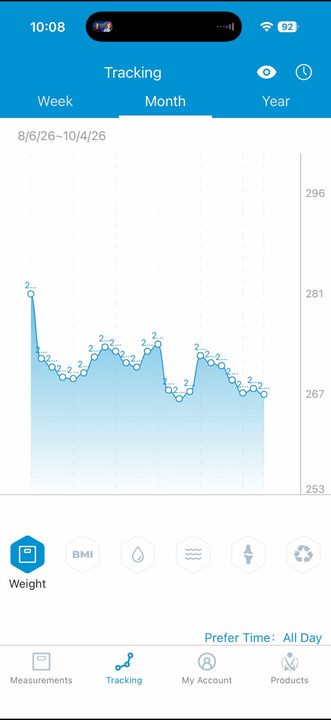
Two months into my GLP-1, the scale says I’ve gone from 281 to 270.
Eleven pounds.
I’ll be honest: a few years ago, that number alone would have made my whole week. For most of us who have struggled with our weight, the bathroom scale has been the judge, the jury, and the mood ring all rolled into one. One number decided whether the day was a win or a failure.
I lived that way for years.
Bouncing between 260 and 300 and back again, I let that number run my head. Up two pounds after a salty dinner and suddenly I’d blown it. Down three after a sweaty day and I was finally figuring it out. Neither one was true, but the scale didn’t care about the truth. It just gave me a number.
[Add a moment from the yo-yo years where the scale wrecked your day or your motivation.]
Here’s the part the old scale never told me: what those pounds were actually made of. Fat, muscle, water, last night’s dinner. A regular scale counts it all the same.
And now that I’m on a GLP-1, that question matters more than it ever has.
The Muscle Problem Nobody Talks About With GLP-1s
When you lose weight, not all of it comes off as fat. Some of it is water, and some of it can be muscle. That’s true with any diet, but the faster the weight comes off and the less you eat, the bigger the risk of losing muscle right along with the fat.
That’s a real concern with GLP-1s. When the medication turns down your appetite, it gets easy to undereat protein without even noticing. I talked about this when I wrote about GLP-1 weight loss and why it isn’t cheating: the medication changes the starting line, but eating enough protein and staying active is still on me.
Why does muscle matter so much?
Because muscle is what keeps you strong, keeps you moving, and helps your body burn a bit more energy even at rest. Lose too much of it and you might hit a lower number on the scale, but feel weaker and have a harder time keeping the weight off long term. And I’m not getting any younger. Holding on to muscle only gets harder every year.
In other words, I don’t just want to weigh less.
I want to be less fat and still strong.
So I needed more than one number.
What a Smart Body Fat Scale Actually Measures
A smart body fat scale looks a lot like a regular bathroom scale, except it has metal pads where your feet go. When you step on barefoot, it sends a very small, harmless electrical current up one leg and down the other. You don’t feel a thing.
That process is called bioelectrical impedance analysis, or BIA for short.
The basic idea is that the current moves through muscle (which holds a lot of water) more easily than it moves through fat. The scale measures that resistance, combines it with the height, age, and sex you put in the app, and estimates what your body is made of.
Depending on the scale, that can include:
- Body fat percentage
- Muscle mass
- Body water
- Bone mass
- BMI
- BMR (roughly how many calories your body burns at rest)
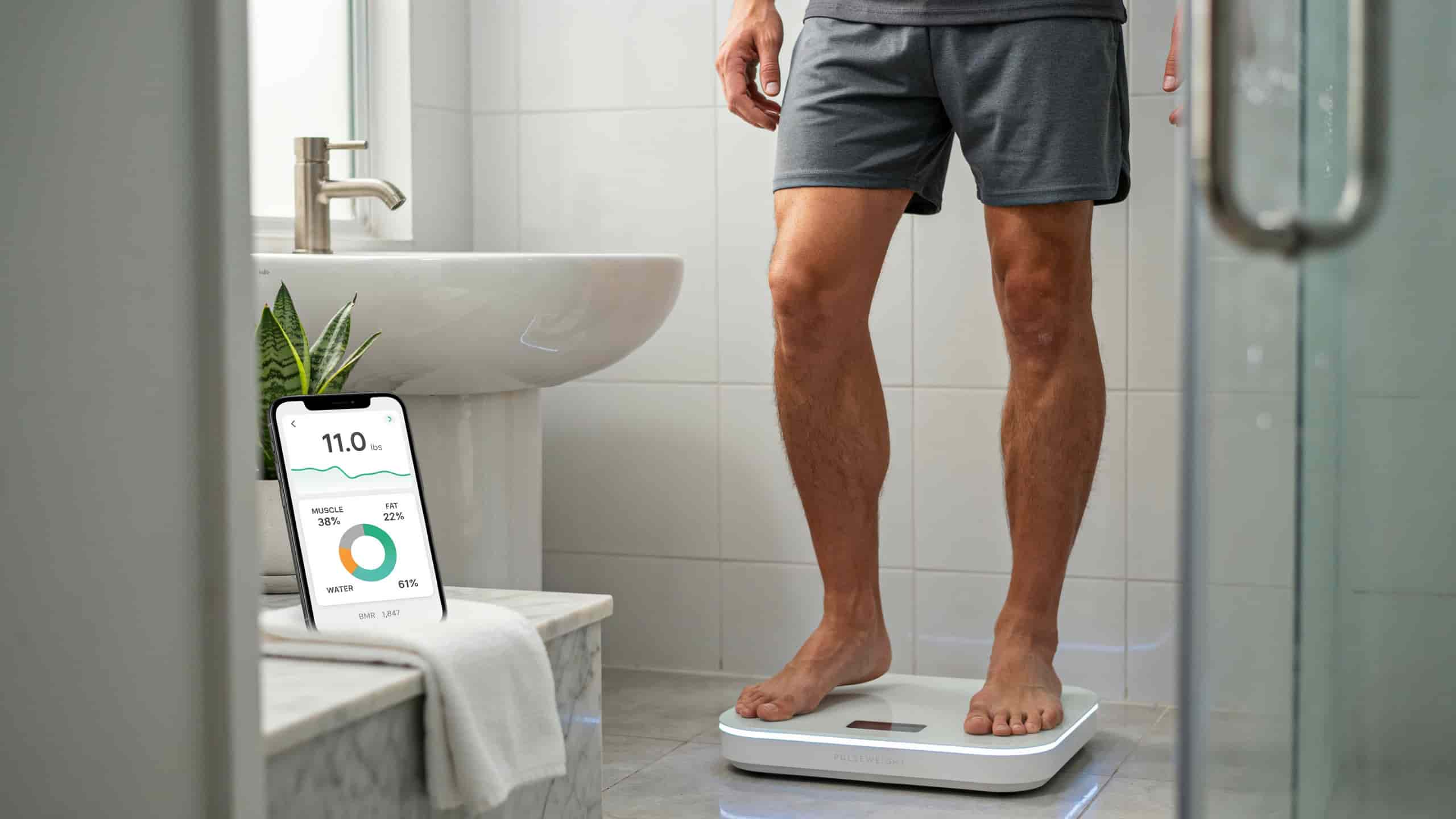
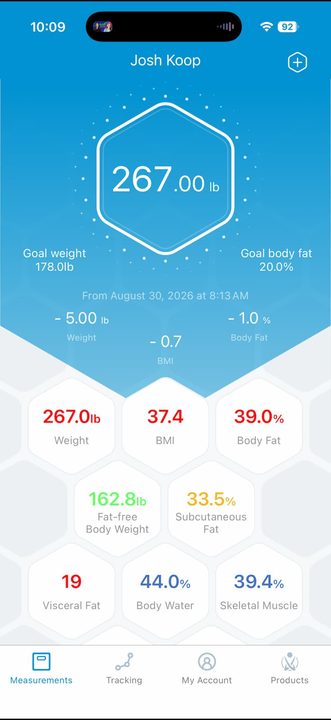
The one I use tracks 13 different metrics, and it all shows up in an app on my phone instead of me trying to remember numbers or scribbling them on a notepad.
The Honest Truth: These Numbers Are Estimates
I’ll be fair here. A scale in your bathroom is not a DEXA scan at a clinic, and anybody who tells you otherwise is selling something.
BIA readings can shift based on how hydrated you are, whether you just ate, whether you just worked out, the time of day, and even how dry your feet are. Your body fat percentage might jump a point overnight.
That doesn’t mean you gained a pound of fat while you were sleeping.
Here’s where these scales actually shine: trends. Same scale, same conditions, over weeks and months. If your body fat percentage is slowly trending down and your muscle mass is holding steady, you’re winning, even during a week where the weight on the scale barely moves.
That’s the whole reason I wanted one. Not for a perfect number. For the direction.
One important safety note: if you have a pacemaker or another implanted electronic medical device, or if you’re pregnant, manufacturers generally warn against using body fat scales. Check the manual and ask your doctor before you use one.
Why I Went With the INEVIFIT Eros
I have used a generic scale for ages, then moved to a FitBit scale, but the FitBit always failed to consistently detect “me” on the scale which meant tracking was always questionable. Thats when I started researching and talking to friends who were tracking similar data who mentioned the Eros being a good option so starting with my GLP-1 journey I added the Eros scale.

Here’s what made it make sense for me:
- 400 lb weight capacity. This matters more than most reviews admit. A lot of cheaper scales top out lower, and if you’ve ever stepped on a scale and gotten an error instead of a number, you know exactly why I’m calling this out.
- Sturdy build. It has a 6mm tempered glass platform, so it doesn’t feel like it’s going to crack under you.
- 13 metrics, including body fat, muscle mass, bone mass, body water, BMI, and BMR.
- Syncs with Apple Health, Google Fit, and Fitbit, so it fits in with whatever you already use to track steps or workouts.
- Unlimited users, so everybody in the house can use it with their own profile.
How I Use It Without Letting It Run My Head
This is the part that matters more than which scale you buy.
A smarter scale can still turn into a smarter way to beat yourself up if you let it. I spent too many years letting a number decide how I felt about myself, and I’m not going back to that.
So here’s how I use it:
- Same time every morning, after the bathroom, before I eat or drink anything
- Same spot on a hard floor, never on carpet
- I look at the weekly trend in the app, not one day’s reading (IMPORTANT)
- One bad reading is just one bad reading. It’s data, not a verdict.
And honestly?
The scale isn’t the only proof that things are changing.
Some of the best progress doesn’t show up on any screen. It shows up in how your clothes fit. I wrote about finding gym clothes that actually fit because what you wear when you work out is part of this whole change, not just a side detail. Clothes that fit right make it easier to show up, and clothes that start fitting looser are a reminder that the work is paying off.
Energy, sleep, taking the stairs without thinking about it. All of that counts too.
So, Is a Smart Scale Worth It? My Honest Answer
For me, yes.
Losing weight was never the real goal. Losing fat while keeping my muscle is. A regular scale can’t tell the difference. A smart scale can give me a decent estimate, as long as I treat it like a trend tool and not a report card.
I think one is worth it if you’re on a GLP-1, if you’re strength training, or if you’ve hit a stretch where the scale won’t move and you need to know whether anything is changing under the surface.
I’ll also be fair about who might want to skip it. If you know that tracking numbers sends you spiraling, or you’ve dealt with disordered eating, more data isn’t automatically better. Talk with your doctor or a therapist about whether tracking is healthy for you, and don’t let anybody, including me, tell you that you have to weigh yourself every day to make progress.
If you’re on a GLP-1 or thinking about it, I’d also start with talking to your doctor about GLP-1 medications, and bring up protein and strength training while you’re there. Those two things matter just as much as the number on the scale.
Because the number on the scale was never the whole story.
Not about your progress, and definitely not about you.
Own the work. Drop the shame. And measure what actually matters.